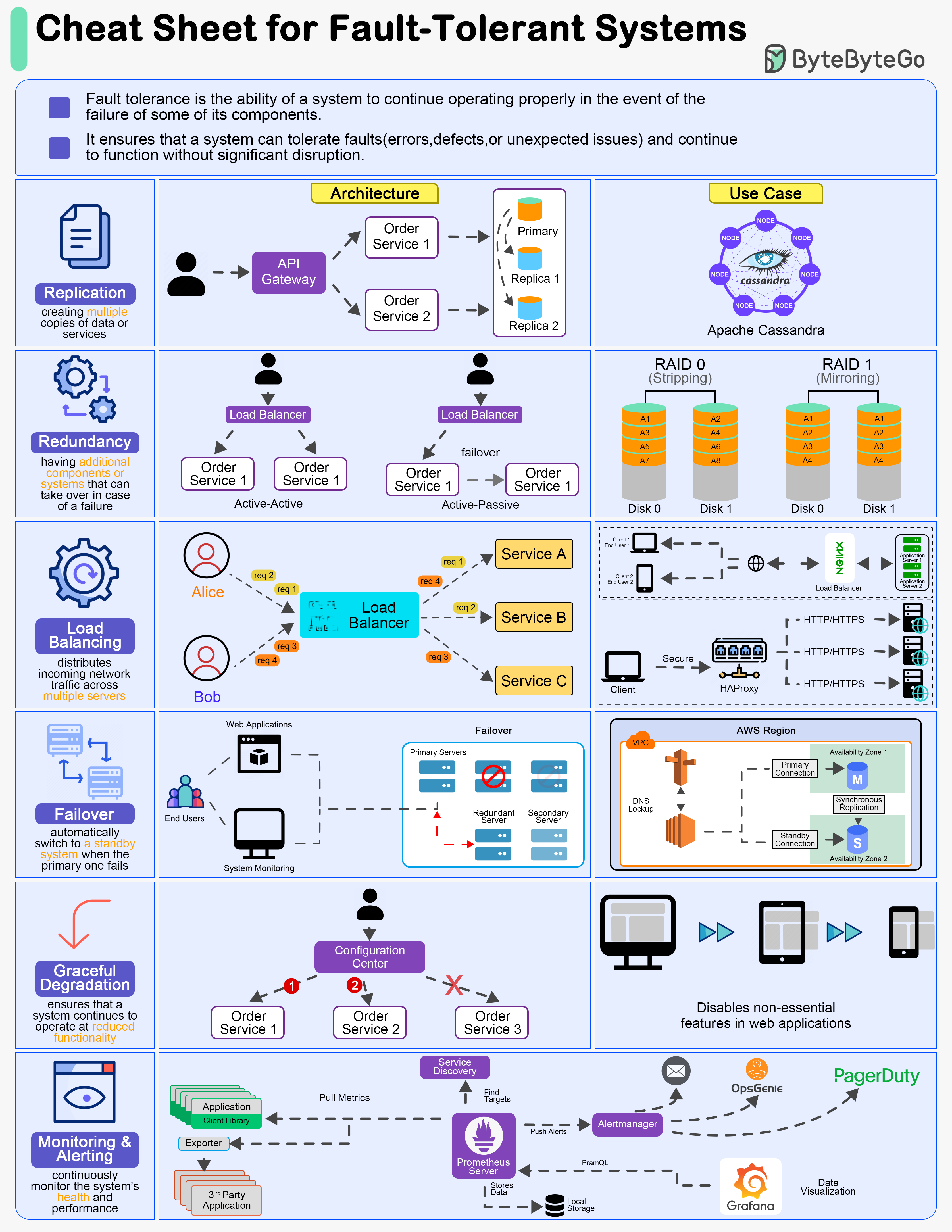
Designing fault-tolerant systems is crucial for ensuring high availability and reliability in various applications. Here are six top principles of designing fault-tolerant systems:
Replication
Replication involves creating multiple copies of data or services across different nodes or locations.
Redundancy
Redundancy refers to having additional components or systems that can take over in case of a failure.
Load Balancing
Load balancing distributes incoming network traffic across multiple servers to ensure no single server becomes a point of failure.
Failover Mechanisms
Failover mechanisms automatically switch to a standby system or component when the primary one fails.
Graceful Degradation
Graceful degradation ensures that a system continues to operate at reduced functionality rather than completely failing when some components fail.
Monitoring and Alerting
Continuously monitor the system's health and performance, and set up alerts for any anomalies or failures.